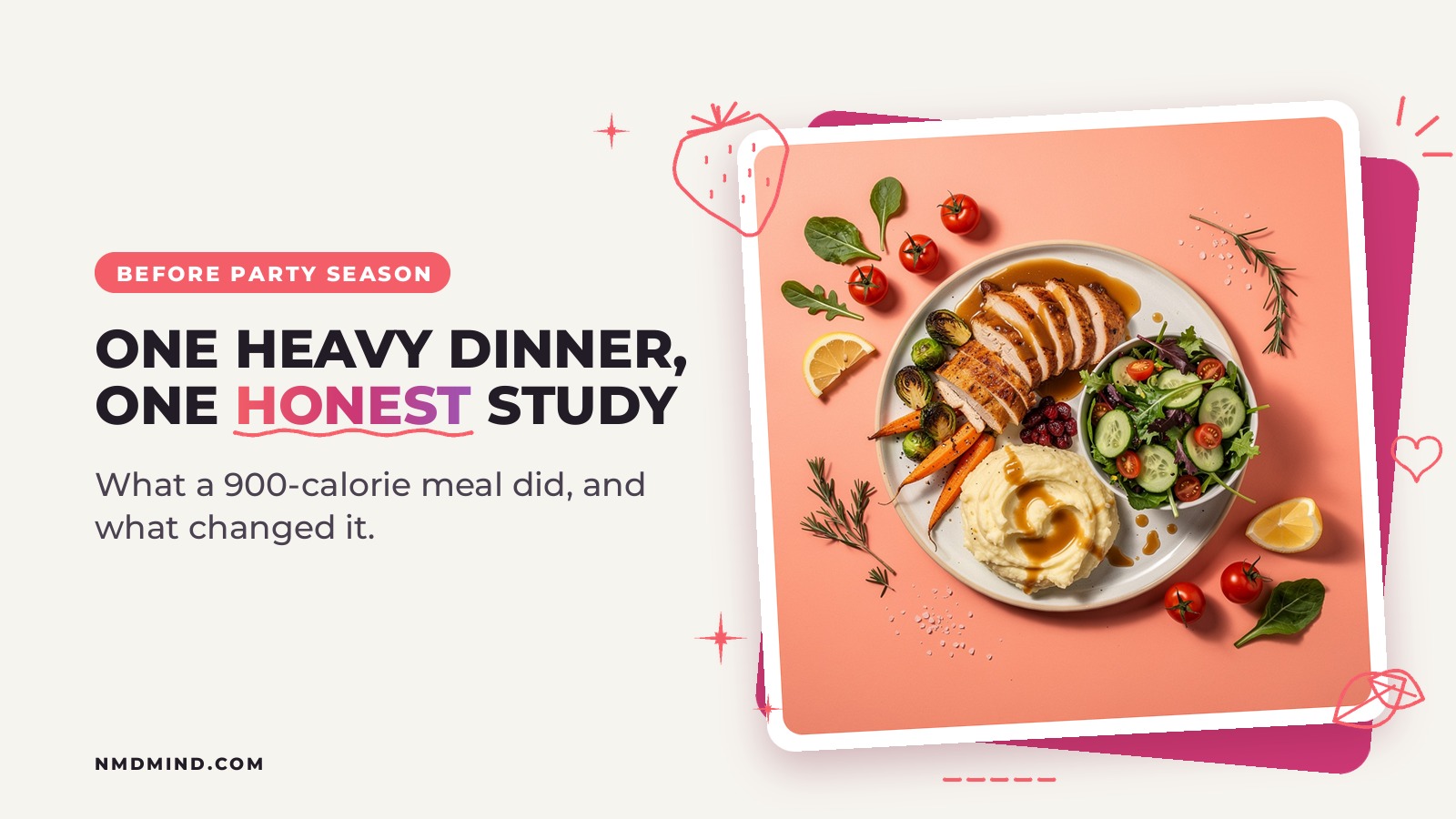
Picture the plate at the office Christmas party. Turkey and ham, roast potatoes, a spoon of stuffing, then a wedge of cheesecake. Nobody’s counting, but a plate like that comes in around 900 calories.
A team of researchers once served healthy volunteers a meal like that on purpose. Three hours later they measured what it had done to the main artery in their arm.
It’s the Juice Plus high fat meal study, and it might be the best talking point you’ll have all December. It fits the exact meals everyone’s about to eat, and it comes with its honesty built in, so you can bring up Juice Plus this month without a single promise.
What the Juice Plus high fat meal study did
Plotnick and colleagues published it in the Journal of the American College of Cardiology in 2003. Thirty-eight healthy adults took part, with an average age of about 36.
The test was simple. Each person ate a 900-calorie meal with 50 grams of fat. Before it, and three hours after, the researchers checked how well the artery in the upper arm opened up when blood flow picked up. A healthy artery widens nicely. After a heavy, fatty meal it widens a good bit less, for at least four hours.
Then the volunteers were split up. One group took Juice Plus fruit and vegetable concentrate every day. A second took it alongside another supplement. A third took a matching placebo. Four weeks later, everyone ate the same heavy meal and got measured again.
So what happened? At the start, the fatty meal cut the artery’s response by about 45 per cent in the Juice Plus group. After four weeks on Juice Plus, the same meal cut it by about 17 per cent. The placebo group barely moved, and the combination group did better again.
The researchers’ own conclusion is that a modest daily amount of fruit and vegetable juice concentrate “can reduce the immediate adverse impact of high-fat meals” on how those vessels respond.
Say the honest bits out loud
This part earns you trust, so give it a minute.
It was a small study. Thirty-eight people, one short-term measure, three hours after one meal. It tells us nothing about heart disease, so leave heart disease out of every conversation you have about it.
And the best line in the whole paper sits right at the top. The researchers point out that eating a green salad with a fatty meal had already been shown to prevent the same dip.
Say that with confidence. It tells your customer that plants on the plate matter, which is the whole reason Juice Plus exists. Real fruit and veg are the gold standard, and the WHO’s healthy diet advice is at least 400 grams of them a day. Few of us get near that in a week of party buffets, which is the everyday fruit and veg gap the capsules are there to bridge.
So how does it come up in real life? Walk through one week in early December with me.
Monday: the customer who’s dreading the food
You drop round a reorder to a customer you’ve had since the summer. She takes the box and groans about the week ahead. Three dos in five days, and her body won’t know what hit it.
That’s your door. No pitch needed. Something like:
“Funny you say that. There’s a study where they gave people a big fatty dinner and measured their arteries after. The ones who’d been taking Juice Plus for four weeks coped a fair bit better. Mind you, the researchers said a green salad does a similar job, so pile the greens on Friday.”
She’ll remember it. If she asks how long before she’d notice anything herself, the four weeks in the study gives you an easy way into the customer timeline chat.
Wednesday: small talk at your own party
Someone at your table asks what you’re doing with “that Juice Plus thing”. Keep it light and keep it short.
“I take it myself. There’s one study I love for this time of year, actually. Heavy dinner, then they checked blood flow, and four weeks of the fruit and veg concentrate made a measurable difference. Small study, but I liked that they said salad works too.”
That last line is the one people remember. You’ve shown them you read the small print. Hardly anyone talking about their own business does that, and the person beside you will clock it.
Friday: one post before the weekend
If you share one thing online before the weekend’s parties, make it the plate and the study. No before-and-after photos, no promises.
Something like: “Party season plate: about 900 calories. A 2003 study measured what a meal like that does to blood flow in healthy people, and four weeks of a fruit and veg concentrate softened the dip. Greens on the side do a similar job. I’m doing both this month.”
When someone comments wanting to know more, send them the post on what antioxidants in fruit and veg actually do. It’s the natural next read.
The line your customers will repeat
Strip the whole week back and one sentence is left standing. Enjoy the dinner, and get the plants in, on the plate or in a capsule.
Your customers will say it at their own parties. That’s how a true, small, honest study does more for you than any big claim ever could.
Pick one customer with a run of Christmas dos in the diary and send her this study before her first one, salad line included.